
Tile Layout Calculator
Calculate the exact number of tiles you need for your floor, wall, or shower project, including grout spacing and overage for cuts.
Project Details
Total Project Area
0.00
Square Feet to cover
Exact Tiles Needed
0
Net amount based on area & grout
Total Tiles Needed (w/ Waste)
0
Recommended purchase amount
Was this Calculator Helpful?
Your feedback helps us improve.
Why Calculate Tile Layout Accurately?
Ordering the correct amount of tile is crucial for project success. Ordering too little means halting your project and risking dye-lot mismatches if you buy a second batch later. Accurately estimating exact tile counts—while accounting for grout lines and proper waste percentages—ensures a seamless installation.
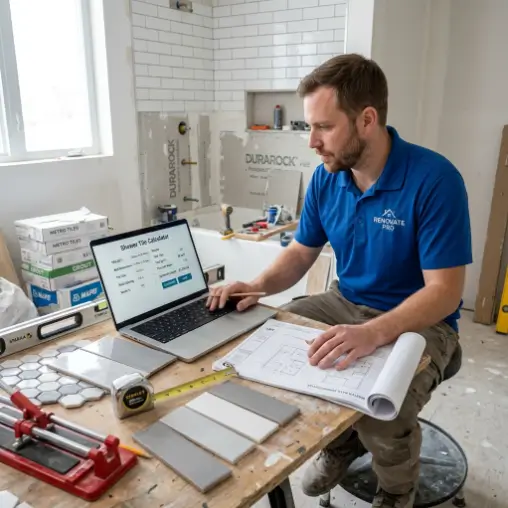
How Our Calculator Works
Measure Total Area
Enter the total length and width of the surface you are tiling. We calculate the exact square footage required for the room.
Account for Grout Lines
Grout takes up space! We mathematically expand the dimensions of a single tile by your chosen grout joint width to get the "effective" tile size.
Apply the Waste Factor
Tiles break, and edges require cutting. We apply an industry-standard waste percentage (10% to 15%) so you have enough material to finish the job.
Formula used in Tile Layout Calculator
Curious about the math? Here is how we estimate the required materials based on standard tiling practices.
Project Area Calculation
We multiply the room's length and width to find the total square footage (or square meters) that needs to be covered by tile.
Effective Tile Area
A tile covers its own surface area plus half of the grout line surrounding it. We add the grout width to the tile dimensions to find its true coverage.
Exact Tiles Needed
By dividing the total project area by the effective area of a single tile, we determine the mathematical exact minimum number of tiles required.
Total Tiles with Waste
We multiply the exact count by your waste percentage to add an overage buffer. This value is always rounded up to the nearest whole tile.
Project Pointers
Tips for Flawless Tile Installation
Prep the Subfloor
Tile requires a rigid, flat surface. Use cement backer board or a self-leveling underlayment to prevent tiles from cracking.
Dry Lay First
Before mixing thinset, "dry lay" your tiles starting from the center of the room to ensure edge cuts are even on all sides.
Choose the Right Trowel
Larger tiles (like 12x24) require trowels with larger notches (like 1/2-inch) to ensure proper mortar coverage beneath.
Seal Natural Stone
If you are installing marble, slate, or travertine, seal the tile *before* grouting so the grout pigment doesn't stain the stone.
Frequently Asked Questions
What waste percentage should I choose?
A standard 10% waste factor is recommended for most straight-lay projects to account for edge cuts and minor breakages. If you are laying tile in a diagonal (herringbone) pattern, or if your room has many corners and obstacles (like a complex bathroom), bump the waste factor to 15% or 20%.
Do I really need to calculate grout lines?
Yes, especially over large areas. If you have a room that is 20 feet long and you use a 1/4-inch grout joint, those joints add up to several inches of space over the span of the room. Factoring them in gives you the true, exact tile count.
How do I calculate multiple walls for a shower?
Calculate the square footage (Length x Width) for each individual wall separately. Add all those square footage totals together, and enter that combined number as the total Project Area Length and a Width of 1 (or just calculate the total area yourself and input dimensions that multiply to it).
What size grout line should I use?
It depends on the tile. Rectified tiles (perfectly straight machine-cut edges) can use very small joints like 1/16" or 1/8". Non-rectified tiles, handmade tiles, or natural stone often require larger grout lines (3/16" or 1/4") to hide slight variations in tile sizes.
Should I keep leftover tiles?
Absolutely. Always try to keep half a box (or at least 3-4 tiles) stored in an attic or garage. If a tile cracks a year down the road due to something dropping on it, finding an exact dye-lot match at the store will be nearly impossible.
What Our Users Are Saying
"I didn't realize how much space 1/4 inch grout lines took up over a 300 sq ft room. This calculator adjusted for it perfectly and saved me from buying an extra box I didn't need."
- Mike T.
"The waste factor toggle is great. I did a herringbone pattern for my kitchen backsplash and bumped it to 15%. I finished the job with exactly 3 tiles left over. Perfect."
- Sarah Jenkins
"Super fast to use. I was literally standing in the tile aisle at Home Depot, typed my bathroom dimensions in, and knew exactly how many boxes to load into my cart."
- Liam O.
"Very helpful tool for my subway tile shower project. It would be cool to add a feature that automatically divides the total tiles by box quantities, but still a 4/5."
- David Construction
"I love the metric option. Being in Europe, measuring rooms in meters and tiles in cm is standard. The math converted flawlessly."
- Robert G.
"A clean, simple interface without annoying ads getting in the way. It accurately predicted the tile count for our sunroom renovation."
- Emma Davis
Have Feedback or a Question?
We'd love to hear from you! If you have suggestions, questions, or just want to say hello, please get in touch.
Go to Our Contact Page